
What Is a Tardigrade?



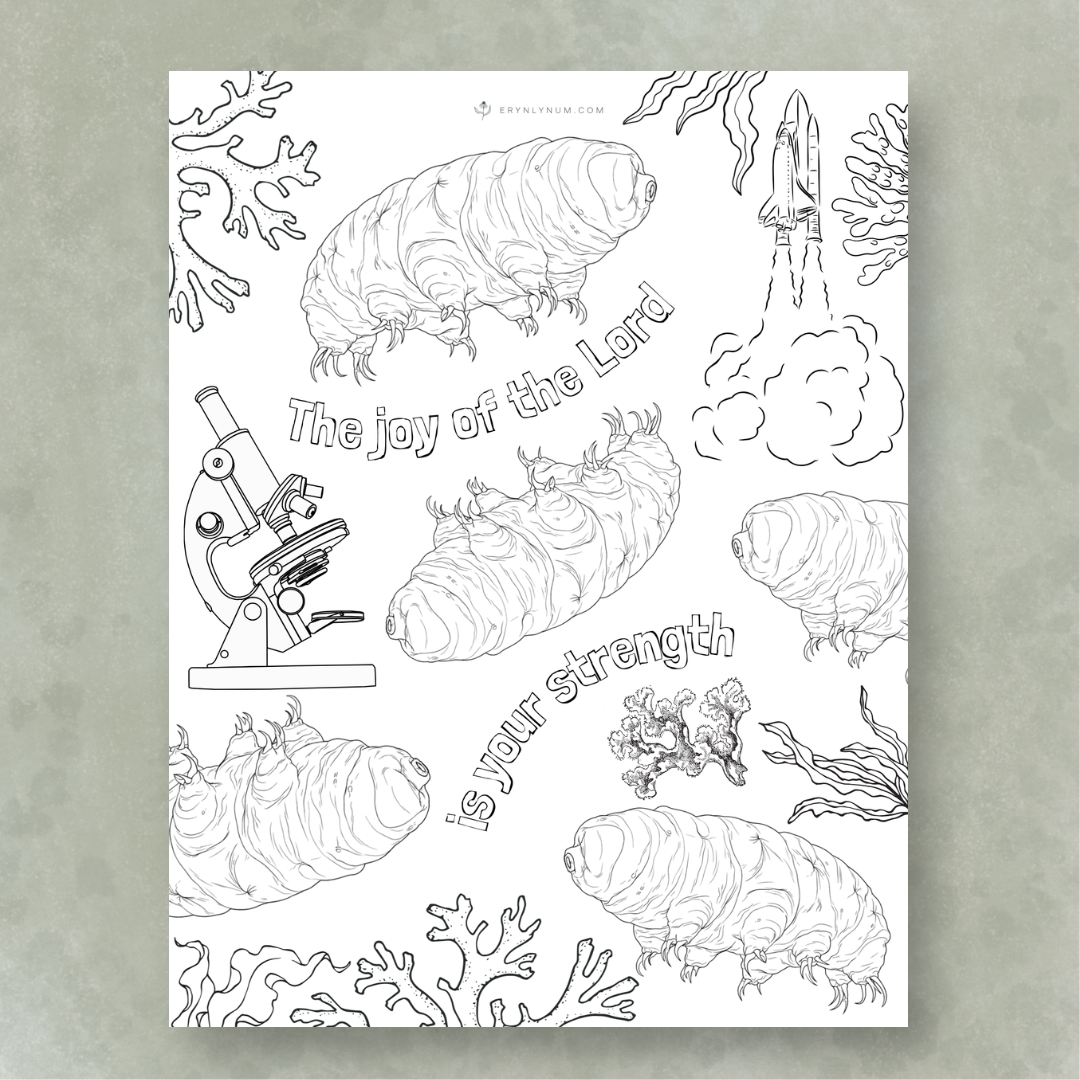
Tardigrade Coloring Sheet

What Is a Tardigrade?
A tardigrade, often called a water bear or moss piglet, is a microscopic animal with eight short, stubby legs and tiny claws. Tardigrades are invertebrates, meaning they do not have a backbone. They belong to their own large category called Tardigrada, with more than 1,200 species. Before microscopes, no one except God knew they were there because they are so small you cannot see them with only your eyes.
Tardigrades have a tough outer layer called a cuticle. As they grow, they molt that cuticle and make a larger one, much like outgrowing clothes. Their bodies look plump and wrinkly, and at the end of each of their eight legs are 4 to 8 tiny claws to grip plants such as moss and lichen.
How Do Tardigrades Eat?
A tardigrade’s face is unique. Some species have simple eye spots, which sense light and dark. Their mouth looks like a tiny circular opening, and inside are two sharp, piercing stylets. A piercing stylet is a hard, sharp mouthpart used to pierce food and sip the fluids inside. Tardigrades drink the juices from plants, algae, and lichen. Some species are carnivorous and use their stylets to feed on other tiny invertebrates, such as nematodes, rotifers, and even other tardigrades.
How Do Tardigrades Grow Up?
A mother tardigrade can lay 1 to 30 eggs, often placing them inside the cuticle she sheds, like a protective nest. When it is time to hatch, baby tardigrades use their tiny stylets to break out of the eggshell, then wriggle out of the mother’s shed cuticle. They are miniature versions of the adults, already equipped with eight legs, claws, and stylets.
Tardigrades grow in a special way. Instead of making more and more new cells, they are born with all the cells they will have. As they grow older, those cells get larger. This kind of growth is called hypertrophy.
Why Are Tardigrades So Tough?
Tardigrades are known for surviving harsh conditions. They can press pause on their metabolism through cryptobiosis. In this state, they pull in their legs, roll into a tight ball called a tun, and dry out, losing about 97 percent of their body moisture. Some can add extra protective layers around the tun in what is called a cyst stage.
They also protect their DNA. Tardigrades make special damage-suppressor proteins called Dsup that act as shields around their DNA. If DNA is damaged, a protein called TDR1 helps repair the damaged spots so cells can function normally again.
Why Tardigrades Inspire Wonder
From their eight tiny legs and claws to their piercing stylets, from eggs tucked safely inside a shed cuticle to cryptobiosis and DNA protection, tardigrades display remarkable design. So, what is a tardigrade? It is a microscopic, slow-stepping animal that showcases God’s marvellous design in the smallest of packages.
Learn more about wild and wonderful tardigrades on our tardigrade podcast for kids:

learn more
Raising kids stirs something deep in our souls — an innate knowing that our time is finite. Taking my kids outside in creation, I’m discovering how to stretch our time and pack it to the brim with meaning. God’s creativity provides the riches of resources for teaching the next generation who He is and how He loves us. Join our adventure and discover inspiration and resources for refusing rush, creating habits of rest, living intentionally, and making the most of this beautiful life!
I'm Eryn, Master Naturalist, Author, & Bible Teacher
Hey there!

Receive free inspirational resources for refusing rush, creating habits of rest, parenting with intentionality, and teaching our kids who God is through what He has made!
Inspired
Be


The Nature of Rest
What the Bible and Creation Teach Us About Sabbath Living
Now Available!
Order
X
Signed Copy
Add a Comment